The AAS Committee on the Status of Women in Astronomy has compiled dozens of interviews highlighting the diversity of career trajectories available to astronomers, planetary scientists, etc. The interviews share advice and lessons learned from individuals on those paths.
Below is our interview with Jörg Matthias Determann, a professor and historian of science in the Department of Liberal Arts & Sciences at Virginia Commonwealth University in Qatar. He holds a doctorate from the School of Oriental and African Studies (SOAS), University of London, and two master’s degrees from the University of Vienna. He is the author of five books including Islam, Science Fiction and Extraterrestrial Life and Space Science and the Arab World. He is also co-editor of a volume on Islamic Theology and Extraterrestrial Life. In February 2024, we profiled his book Diversity, Equity, and Inclusion in Astronomy; see a summary here.
What were the most important factors that led you to study the history of science / astronomy?
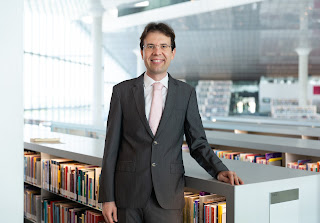 |
Matthias in the Qatar National Library.
Credit: Kateryna Reshetova |
My family was a very important factor. My paternal grandfather Fritz Determann was a mathematician who spent most of his career working for Carl Zeiss AG, inventing optical systems and developing software. Although mostly based in Germany, he also contributed to observatories in Iraq and Japan and to a planetarium in Denmark. Even decades after his retirement, he used Fortran to calculate orbits of satellites on his personal computer. Through countless conversations, he cultivated in me an interest in astronomy and science more generally. At the same time, other family members, including my mother Sibylle Determann (a trained historian), inspired me to study history. As an undergraduate at the University of Vienna in Austria and later as a graduate student at the University of London in the UK, I found out I could combine my interests in the natural and the social world by taking courses in the history of science.
How have you been able to parlay that interest into your career?
In 2013, a year after completing a doctoral thesis in history, I was very fortunate to be offered a faculty position in the Department of Liberal Arts & Sciences on the Qatar campus of Virginia Commonwealth University. This department has physicists, mathematicians, and scholars of the humanities all under one roof. It has been a perfect place for me as someone who has been interested in both history and science.
If you have made a career change, what was your age at the time?
My first job after my undergraduate education was to teach German at King Saud University in Riyadh, Saudi Arabia. While I greatly enjoyed working at a university, I wanted to pursue history. After a year in this position, I thus enrolled in a doctoral program in history at the School of Oriental and African Studies (SOAS), University of London.
What, if any, additional training did you complete in order to meet the qualifications?
During my graduate studies at the University of London, I completed a Graduate Teaching Assistant Training Programme accredited by the Higher Education Academy in the United Kingdom. This has provided me with a very useful basis for subsequent professional development as an educator.
Describe job hunting and networking resources you used and any other advice/resources.
As I was finishing my doctorate, I started applying for jobs in Europe, Asia and the Americas. After first gaining a postdoctoral position in Germany, I had interviews for faculty roles at universities in Qatar, Saudi Arabia and the United Arab Emirates. I would advise graduate students interested in an academic career to apply for jobs internationally as well.
What has been your career path since you completed your degree?
After completing my doctorate at the University of London in 2012, I was a postdoctoral researcher at Zentrum Modern Orient and Freie Universität Berlin. In 2013, I was lucky enough to become an assistant professor at Virginia Commonwealth University in Qatar. I have been there ever since and was very grateful to be promoted to associate professor in 2019 and full professor in 2023.
What have been particularly valuable skills for your current job that you gained through completing your degree?
My doctoral studies gave me the skills of managing a multi-year research project and producing a book-length object as a result. This is what I still do, just on different topics.
 |
At the University of Vienna's Astronomy library
during the covid-19 pandemic in 2021. |
Describe a typical day at work.As a historian, I probably spend more time in libraries and archives than a typical astronomer. However, as is the case for astrophysicists, my data increasingly exists in digital form. So, when I am not teaching in the classroom or meeting students and colleagues in my office or conference rooms, you probably find me sitting at my desk in front of my laptop. For good reason, my four-year-old daughter Maria’s mental image of me “at work” is me at my computer.
I am very lucky that neither I nor my boss count
my hours. However, I am working full-time with
added voluntary service. Additonally, my salary
is based on that of a full-time faculty member at Virginia Commonwealth University’s campuses in the United States. It is supplemented by different allowances in accordance with the laws of Qatar. I am highly satisfied with my job. I have had wonderful supervisors and departmental colleagues who have always supported my teaching, research and service.
What are the most enjoyable aspects of your job and the work environment?
I love teaching the most. My classes at Virginia Commonwealth University are small, consisting of around fifteen students on average. This allows me to get to know my course participants very well. Many of them also continue to live in Doha after graduation and stay in touch with me. This gives me the chance to mentor them over many years.
Qatar has a very diverse population, which is also reflected in the body of students and employees on Virginia Commonwealth University’s campus. I have had colleagues from all continents and many different religions. Moreover, VCU’s building is part of an Education City that also includes branches of other American universities, such as Cornell, Georgetown and Northwestern. I am thus in close proximity to other excellent institutions with interdisciplinary programming. Between 2019 and 2023, I was a guest lecturer at a seminar at Georgetown University entitled “Interstellar Relations: Science Fiction and Politics,” for example.
What opportunities does your job provide to be creative and/or to take initiative?
I am blessed with many opportunities for creative initiatives that bridge different disciplines. In 2022, for example, I hosted a conference on “Islamic Perspectives on Exotheology” which resulted in an edited volume entitled Islamic Theology and Extraterrestrial Life: New Frontiers in Science and Religion.
Tell us a little bit about work-life balance. What advice do you have for achieving work-life balance (including having a family)?
 |
Matthias' daughter at the Al Thuraya
Planetarium in Doha (2021). |
|
I am very satisfied with my work-life balance. Although parts of the academic year can get very busy with teaching and service opportunities, I have downtimes during breaks. My book on Diversity, Equity, and Inclusion in Astronomy was a multi-year project, and in between the different deadlines, I had considerable flexibility in how to manage my time.
As for advice, don’t procrastinate and get your work done early so that you can fully enjoy other activities! As for having children, my wife Jeanne Vaz, who has always worked full-time as well, would say: “Focus on the reality you want and then work towards that.” I have always wanted a child whom I could take to my office or to a lecture. From an early age, we thus cultivated discipline in our daughter Maria, including the ability to sit quietly for long periods and draw. At the same time, we stimulated her interest in astronomical topics, so that she would not get bored when listening to a presentation of mine. Her bedroom is space-themed and her shelves full of children’s books about science and science fiction.
How family-friendly is your current position?
My position is very family-friendly. I am on a generous expatriate contract that includes medical insurance and an annual travel allowance for my wife and daughter. I enjoy long summer breaks from teaching and administrative meetings, which coincide with my daughter’s school holidays in July and August. Finally, my work does not require much travel, as I am able to gather most data for my research via the Virginia Commonwealth University libraries, the Qatar National Library and the internet. Virtually all of my interviews for my book on Diversity, Equity, and Inclusion in Astronomy were conducted remotely.
What do you do for fun (e.g., hobbies, pastimes, etc.)?
I love swimming. In Qatar, it is warm enough for outdoor water sports for much of the year. The infrastructure in the country is excellent too, with professional facilities built for the 2006 Asian Games and the 2024 World Aquatics Championships. Science fiction in its different media, from literature to film and video games, has been a hobby as well as professional interest of mine. I greatly enjoy reading children’s science fiction books to my daughter Maria. In my volume on Diversity, Equity, and Inclusion in Astronomy, you will find many references to Star Trek.
Can we include your email address for people who may want to contact you directly about your specific career route?
Yes, please. My email address is jmdetermann_at_vcu.edu. They can also get in touch with me via social media. I am on X (formerly Twitter) at
@JMDetermann and on Instagram at
@jmdetermann.
Check out more of Matthias' work: